
In the rapidly evolving landscape of the mid-2020s, a single, fixed skillset is no longer a passport to a lifelong career. The concept of education as a finite phase—confined to the first two decades of life—has been rendered obsolete.
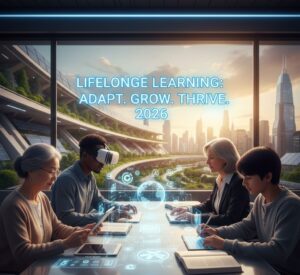
In its place stands lifelong learning, the self-motivated, continuous pursuit of knowledge and skills for personal or professional development throughout an individual’s lifespan. As we navigate 2026, this is no longer a mere aspirational ideal for the curious few; it has become an economic imperative, a cornerstone of personal well-being, and a fundamental strategy for societal resilience.
Defining the Modern Lifelong Learner
Lifelong learning in 2026 transcends the traditional image of evening classes or periodic training seminars. It is an integrated, agile, and often digital-first mindset. It is characterized by:
-
Agency and Proactivity: The modern learner drives their own educational journey. They don’t wait for an employer mandate; they identify skill gaps, technological shifts, and personal interests, then seek out resources to address them.
-
Micro and Modular: Learning is chunked into manageable, on-demand modules. Nanodegrees, micro-credentials, short-form video tutorials, and interactive simulations allow for targeted skill acquisition without the commitment of a multi-year degree.
-
Deeply Integrated with Technology: Artificial Intelligence acts as a personal tutor, curating learning pathways, adapting content difficulty, and providing instant feedback. Immersive technologies like Virtual Reality (VR) and Augmented Reality (AR) enable hands-on practice in safe, simulated environments—from repairing complex machinery to performing delicate surgical procedures.
-
Formal and Informal: It values the credibility of a professional certification from a major platform like Coursera or edX just as much as the practical wisdom gained from a expert-led community on Discord or a deep-dive series on YouTube. The focus is on competency and application, not solely on institutional pedigree.
The Imperative Drivers in 2026: Why It’s Non-Negotiable
Several convergent forces have solidified lifelong learning from a “nice-to-have” to a “need-to-survive” by 2026.
1. The Accelerating Pace of Technological Disruption
The twin engines of Artificial Intelligence and automation continue to redefine the workplace. In 2026, AI is less a standalone tool and more a collaborative partner, handling routine data analysis, content generation, and administrative tasks. This doesn’t simply eliminate jobs; it transforms them. Roles now require “robot-proof” skills: complex problem-solving, critical thinking, creativity, and emotional intelligence. The half-life of technical skills has shrunk further; a programming language or a marketing platform mastered in 2023 may be outdated by 2026. Continuous upskilling and reskilling are the only ways to remain relevant and leverage new tools rather than be displaced by them.
2. The Dynamic Global Economy and Gigification
The global economy is increasingly project-based and fluid. The rise of the gig economy, remote hybrid work, and portfolio careers means professionals are no longer employees of a single company for life. They are their own brands, moving between projects, clients, and industries. In this ecosystem, a diverse and constantly updated skills portfolio is your currency. Learning agility—the ability to quickly learn, unlearn, and relearn—becomes the most valuable meta-skill, determining one’s ability to seize new opportunities and navigate economic uncertainty.
3. The Longevity Revolution and Multi-Stage Life
With increasing life expectancy, the traditional three-stage life model (education, work, retirement) is collapsing. People in 2026 are looking at 60-year careers, punctuated by sabbaticals, career pivots in their 50s, and “encore” pursuits post-retirement. Lifelong learning is the glue that holds this multi-stage life together. It enables a 45-year-old manufacturing manager to reskill into sustainable energy logistics, a 60-year-old teacher to transition into educational technology consulting, or a retiree to finally study philosophy or digital art. Learning becomes the mechanism for renewal and purpose across decades.
4. Personal Fulfillment and Cognitive Health
Beyond economics, the intrinsic value of learning is paramount. In a world of digital noise and constant distraction, the deliberate focus required to master a new skill—be it a language, a musical instrument, data analysis, or gardening—provides a profound sense of agency and accomplishment. Neuroscientific research continues to affirm that challenging the brain with new learning builds cognitive reserve, staving off decline and enhancing mental agility. In 2026, learning is widely recognized as a critical component of holistic well-being, akin to physical exercise and mindfulness.
The Ecosystem of Lifelong Learning in 2026
The infrastructure supporting this journey is sophisticated and accessible:
-
Corporate Academies & Learning Experience Platforms (LXPs): Forward-thinking companies have moved beyond compliance training. They offer curated, Netflix-style learning platforms with personalized recommendations, incentivizing skill acquisition that benefits both the employee and the organization’s adaptability.
-
The Credentialing Revolution: Digital badges and blockchain-verified micro-credentials provide portable, verifiable proof of specific competencies, creating a more nuanced and skills-based alternative to traditional diplomas.
-
Community-Powered Learning: Learning is social. Platforms like Mighty Networks and dedicated subreddits foster communities of practice where peers mentor, challenge, and collaborate, making the journey less isolating and more application-focused.
-
Public Policy and Initiatives: Governments, recognizing the macroeconomic need, are promoting initiatives like individual learning accounts (ILAs), which provide citizens with funding for approved courses throughout their lives, and incentivizing employer-led training programs.
Overcoming the Barriers: The Challenge of Access and Equity
Despite the tools, significant challenges remain. The digital divide can become a learning divide. Those without reliable high-speed internet, modern devices, or digital literacy are at severe risk of being left behind, exacerbating existing socioeconomic inequalities. Furthermore, the mental bandwidth required for self-directed learning after a demanding workday—the “second shift” of learning—can lead to burnout.
Addressing this requires conscious effort: employers granting dedicated “learning time,” institutions designing more accessible, low-cost pathways, and a cultural shift that frames learning not as an extracurricular burden, but as an integral, supported part of daily life.
The Lifelong Learner’s Mindset: Your Greatest Asset
Ultimately, in 2026, success hinges on cultivating a specific mindset:
-
Intellectual Curiosity: An insatiable “why?” and “how?” that drives exploration.
-
Growth Mindset: The bedrock belief that abilities are not fixed but can be developed through effort and strategy. Viewing challenges and even failure as learning data, not personal indictment.
-
Disciplined Adaptability: The discipline to consistently dedicate time to learning, coupled with the flexibility to pivot when information or circumstances change.
-
Strategic Self-Awareness: The ability to honestly audit one’s own skills, anticipate industry trends, and map a learning journey that aligns with both market needs and personal passions.
Conclusion: Learning as the Constant in a World of Change
As we stand in 2026, the only true constant is change itself. In this environment, lifelong learning is the ultimate adaptive strategy. It is the process through which we future-proof our careers, enrich our personal lives, maintain our cognitive vitality, and contribute meaningfully to a society in flux.
It is no longer about accumulating knowledge in a static repository, but about building a resilient, agile neural network of skills and understanding that can reorganize and grow as needed. The question for individuals, organizations, and governments in 2026 is not whether to embrace lifelong learning, but how quickly and inclusively they can build the systems and cultivate the culture to make it a reality for all. The future will not belong to those who know the most, but to those who learn the most effectively and courageously throughout the entirety of their lives.