
The choice between online courses and traditional classroom learning has evolved from a niche debate into a central question for students, professionals, and institutions worldwide. The rise of high-speed internet, sophisticated learning platforms, and global events like the pandemic have propelled digital education into the mainstream, forcing a reevaluation of what “better” really means. Framing this
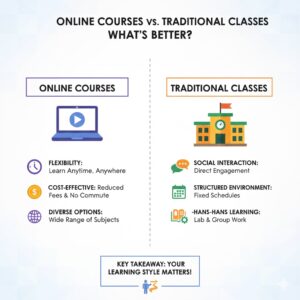 as a simple dichotomy with a universal winner is misleading; the true answer is nuanced and hinges entirely on individual goals, learning styles, and life circumstances. This analysis moves beyond hype and nostalgia to dissect the core strengths and limitations of each modality, providing a framework for making a personal, empowered choice.
The Case for Online Learning: Flexibility, Access, and Personalization
Online education is not a single entity but a spectrum, ranging from massive open online courses (MOOCs) to live, interactive virtual classes and intensive bootcamps. Its advantages are profound and have redefined who can learn and when.
-
Unmatched Flexibility and Convenience:
This is the cornerstone of online learning’s appeal. It decouples education from geography and a fixed schedule. Learners can access lectures, complete assignments, and participate in forums at 2 PM or 2 AM, fitting education around work, family, or other commitments. This asynchronous capability is revolutionary for adult learners, career-changers, parents, and those in remote locations. It enables lifelong learning as a continuous, integrated part of life, not a disruptive, all-or-nothing endeavor. -
Global Access and Diversity:
An online platform erases physical borders. A student in a small town can take a course from a professor at Stanford, MIT, or Oxford. Furthermore, the virtual classroom often hosts a more geographically, culturally, and professionally diverse cohort than any single university campus. This diversity enriches discussion forums and project work with a wider range of perspectives, preparing students for a globalized workforce. -
Self-Paced Progression and Scalability:
Many online courses allow learners to speed through familiar material and slow down for complex topics. This self-paced model respects individual differences in prior knowledge and processing speed. For institutions, this scalability makes specialized knowledge accessible to tens of thousands simultaneously, democratizing education in unprecedented ways. -
Lower Direct Costs and Reduced Overhead:
While not always cheap, online programs frequently have lower tuition fees than their on-campus counterparts. Students also save significantly on ancillary costs: no commuting (fuel, parking, public transit), no relocation, and often no requirement for expensive physical textbooks. This reduction in financial and logistical barriers can be decisive. -
Skill-Specific, Agile Curriculum:
The online ecosystem excels at delivering focused, just-in-time training. Platforms like Coursera, Udacity, and LinkedIn Learning are built to rapidly deploy courses on emerging skills—AI prompt engineering, blockchain fundamentals, or advanced data visualization—often developed in direct partnership with industry leaders. This agility is hard for traditional degree programs, with their longer accreditation cycles, to match.
The Pitfalls of the Digital Realm:
However, the online model presents distinct challenges. It demands a high degree of self-discipline and intrinsic motivation; without the structure of a set class time, procrastination is a real threat. The lack of spontaneous, face-to-face interaction can lead to feelings of isolation and make building meaningful peer networks more difficult. Furthermore, learning complex physical or hands-on skills (surgery, welding, advanced laboratory techniques) is severely limited in a purely virtual environment, and not all subjects translate well to a digital format.
The Case for Traditional Classes: Structure, Immersion, and Social Learning
The traditional classroom—a physical space where instructors and students share time and location—remains the archetype of education for good reason. Its benefits are deeply rooted in human social and psychological needs.
-
Structured Routine and Tangible Accountability:
The fixed schedule of a traditional class creates a powerful external framework. This routine minimizes the need for self-directed planning and combats procrastination. Physically showing up, being seen by an instructor and peers, and participating in real-time creates a layer of social accountability that many learners find essential for consistency. -
Rich, Immediate Social Interaction:
This is the irreplaceable core of the traditional experience. The classroom facilitates not just formal learning but also the “hidden curriculum” of soft skills: reading body language, engaging in spontaneous debate, collaborating on a whiteboard, and navigating group dynamics in real time. The camaraderie built during late-night study sessions in the library, coffee breaks between classes, and casual conversations in hallways fosters deep peer networks and mentorship opportunities that often form the foundation of professional careers. -
Direct, Dynamic Access to Instructors:
The ability to raise a hand for immediate clarification, approach the professor after class for a nuanced discussion, or receive instant feedback on a facial expression of confusion is a high-bandwidth communication channel. This real-time feedback loop allows for adaptive teaching, where an instructor can pivot on the spot based on the room’s energy and comprehension. -
Access to Physical Infrastructure and Hands-On Learning:
Universities and colleges are not just collections of classrooms; they are hubs of physical resources. This includes science laboratories, art studios, performance theaters, engineering workshops, athletic facilities, and vast research libraries. For disciplines where kinesthetic or sensory experience is paramount, this hands-on access is non-negotiable. You cannot become a proficient chemist or cellist through a screen alone. -
The Holistic “Campus Experience”:
Traditional education often offers a holistic developmental journey. It encompasses extracurricular activities, clubs, sports, leadership roles, and campus events that contribute to personal growth, identity formation, and a sense of community belonging. This immersive environment is designed for the full development of a young adult, not merely the transfer of information.
The Limitations of the Brick-and-Mortar Model:
Conversely, traditional education can be inflexible and inaccessible. Its fixed schedule and location are prohibitive for those with full-time jobs or family obligations. It is often significantly more expensive, factoring in tuition, housing, and campus fees. The pace of the curriculum is usually set for the median student, which can frustrate both quick and slower learners. Finally, the geographical constraint limits the diversity of the student body and faculty to those who can physically be present.
The Convergence: The Rise of Hybrid and Blended Learning
The most insightful perspective recognizes that the future isn’t a choice between two poles, but a strategic blending of both. The “Hybrid” or “Blended Learning” model intentionally combines the best of both worlds.
-
Example – A Modern University Course: A biology class might have lecture materials (recorded videos, interactive simulations) available online for self-paced study, freeing up in-person class time for active learning: guided lab work, small-group problem-solving, and deep Q&A sessions with the professor. This “flipped classroom” model uses online efficiency to enhance the value of precious face-to-face time.
-
Example – A Corporate Training Program: New employee onboarding might begin with a series of online modules covering company history and software use (consistent and scalable), followed by an in-person workshop focused on team-building, role-playing client interactions, and cultivating company culture.
This model maximizes flexibility while preserving essential human connection and hands-on practice. It requires sophisticated design but represents the most adaptive and resilient approach to modern education.
Making the Choice: A Diagnostic Framework
So, what’s better for you? Ask these questions:
-
What is my learning style?
-
Are you highly self-disciplined and an independent learner? Online may be empowering.
-
Do you thrive on external structure and learn best through discussion and observation? Traditional may be more supportive.
-
-
What are my life and logistical constraints?
-
Do you have a full-time job, family duties, or live far from institutions? Online flexibility is likely essential.
-
Can you commit to a fixed schedule and location for a sustained period? Traditional is feasible.
-
-
What is the specific subject or skill I want to master?
-
Is it knowledge-based, cognitive, or software-driven? (e.g., History, Programming, Data Analysis): Online can be excellent.
-
Does it require physical practice, lab work, or intensive interpersonal skill? (e.g., Clinical Nursing, Sculpture, Acting): Traditional is often necessary.
-
-
What is my goal?
-
Is it rapid skill acquisition for career advancement? A targeted online course or bootcamp may be the most efficient path.
-
Is it a comprehensive degree, research opportunities, and a transformative life experience? A traditional program may offer the complete package.
-
Conclusion: Better is Contextual, Not Absolute
The debate between online and traditional classes is not a contest with one winner. It is a clarification of two powerful, complementary tools in the modern learning arsenal.
Online learning wins on the axes of scale, flexibility, accessibility, and cost-efficiency for specific skill acquisition. It is the engine of democratized, lifelong learning.
Traditional learning wins on the axes of social immersion, hands-on practice, structured accountability, and holistic development. It remains the gold standard for complex, experiential education and deep community formation.
The most empowered learners and forward-thinking institutions will reject a forced choice. They will seek out or create blended experiences that harness digital efficiency to enable deeper human interaction. Ultimately, the “better” model is the one that is deliberately chosen to align with your personal psychology, your real-world constraints, and the specific nature of the knowledge you seek to build. In the landscape of 21st-century education, understanding the terrain is the first step to navigating it successfully.