
In a world saturated with linear information—endless bullet points, dense paragraphs, and monotonous lists—our brains often struggle to see the forest for the trees. We collect data points but fail to grasp the overarching connections that give them meaning and make them memorable. Enter mind mapping,
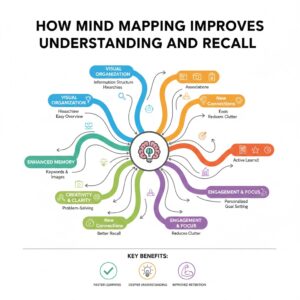 a deceptively simple visual technique that aligns powerfully with the brain’s natural architecture for thinking, learning, and remembering. More than just a colorful diagram, a mind map is a direct external representation of how our neural networks organize information. By leveraging spatial reasoning, visual cues, and associative thinking, mind mapping transforms passive note-taking into an active process of understanding, dramatically improving both comprehension and long-term recall.
The Cognitive Science: Why Your Brain Loves a Map
To appreciate why mind mapping is so effective, we must first understand how the brain processes and stores information.
-
The Brain is Non-Linear and Associative:
Contrary to the linear format of traditional notes, the brain does not think in straight lines or bullet points. It operates radiantly, branching out from a central idea in an explosive, connective manner. One thought triggers multiple associations, which in turn spark further connections. A mind map, with its central topic and radiating branches, mirrors this exact radiant thinking process, providing a “native format” for the brain to process information. -
Dual Coding Theory in Action:
Psychologist Allan Paivio’s Dual Coding Theory posits that information is stored in two distinct but interconnected systems: one for verbal/linguistic information (words) and one for visual/imaginative information (images). When information is presented both verbally and visually, the two codes create stronger, more redundant memory traces. A mind map is the epitome of dual coding: it combines keywords (verbal) with spatial arrangement, colors, icons, and images (visual), giving the brain two pathways to retrieve the information later. -
Engaging the Whole Cortex:
Traditional linear notes predominantly engage the left hemisphere of the brain, which is analytical, logical, and sequential. Mind mapping actively recruits the right hemisphere, which is responsible for spatial awareness, color, rhythm, and holistic thinking. By engaging both hemispheres in a synergistic “whole-brain” activity, mind mapping creates a richer, more integrated cognitive experience, leading to deeper encoding and more creative insights. -
The Power of Chunking and Hierarchy:
Our working memory—the mental workspace where we manipulate information—is severely limited, capable of holding only about 4-7 “chunks” of information at once. Mind maps overcome this bottleneck by chunking information into meaningful, visually distinct groups (branches). They also impose a clear hierarchy, with main themes attached to the center and finer details nested on sub-branches. This organization reduces cognitive load, allowing the brain to see complex relationships at a glance without becoming overwhelmed.
The Anatomy of an Effective Mind Map: More Than Doodles
A powerful mind map isn’t just random branches; it follows core principles that optimize its cognitive benefits:
-
A Central Image: The process begins with a compelling visual representation of the main topic at the center of the page. This image acts as the anchor, engaging the visual cortex and making the map more memorable.
-
Curved, Organic Branches: Thick, flowing branches radiate out from the center, each representing a key main theme. The use of curved lines (vs. straight) is more stimulating to the eye and feels more natural.
-
One Keyword Per Line: Each branch holds only a single, essential keyword or concise phrase. This forces the mapper to distill concepts to their essence, enhancing clarity and allowing for maximum association from that single concept.
-
A Colorful Palette: Each main branch and its subsequent sub-branches are given a distinct color. Color codes information, visually groups related concepts, and dramatically boosts recall and interest.
-
Images and Symbols Throughout: Icons, sketches, and symbols replace or accompany text wherever possible. A small lightbulb for an idea, a question mark for uncertainty, or a simple sketch of a heart for “cardiovascular system” create instant, memorable cues.
From Passive Reception to Active Construction: How Mapping Enhances Understanding
The act of creating a mind map is where the magic of understanding happens. It shifts the learner from a passive receiver to an active constructor of knowledge.
-
Forces Synthesis, Not Transcription: When listening to a lecture or reading a text, the linear note-taker often falls into the trap of frantic transcription, capturing words without processing meaning. The mind mapper must pause, identify the central idea, determine key themes, and decide on hierarchy. This process of selection, judgment, and organization is the very act of synthesis that leads to genuine understanding.
-
Reveals Gaps and Relationships: As branches extend, the visual layout makes it immediately apparent where information is missing, where connections between separate branches might exist, or where certain concepts are disproportionately detailed. This “knowledge audit” prompts critical questions and deeper inquiry.
-
Facitates “Big Picture” Thinking: By placing every piece of information in relation to a central whole, the mind map prevents getting lost in details. It constantly reinforces the context, answering the critical learner’s question: “How does this detail relate to the main goal?”
Example – Understanding a Complex Novel:
A student reading Moby Dick could take linear notes on plot, characters, and themes separately. A mind map, however, would start with an image of the white whale at the center. Main branches could be Characters (Ahab, Ishmael, Queequeg), Themes (Obsession, Man vs. Nature, Religion), Symbols (The Whale, The Sea, The Pequod), and Historical Context. The visual map would allow the student to draw a line connecting Ahab (Character branch) directly to Obsession (Theme branch), and link that to the symbol of the Whale. The understanding becomes networked, not siloed.
The Recall Superhighway: Why Mind Maps Make Memories Stick
The structure of a mind map builds a superior retrieval system for memory. It leverages several key principles of memory science:
-
The Von Restorff Effect (Isolation Effect):
This psychological phenomenon states that an item that stands out distinctly (is “isolated”) from its surroundings is more likely to be remembered. In a mind map, the use of a central image, unique colors per branch, and personalized icons makes each piece of information visually distinct, creating multiple “Von Restorff” highlights throughout the diagram. -
Association and Neural Pathways:
Memory is associative. The brain recalls information by traveling along pathways of linked concepts. A mind map is literally a web of these associations. During recall, remembering the central image can trigger the memory of the main branches (color-coded), which then trigger the keywords on those branches, and so on. The map provides a ready-made navigation route for your memory. -
Spatial Memory as a Scaffold:
Humans have an exceptionally strong spatial memory. We remember where things are located in physical space. A mind map leverages this by giving information a “home” on the page. During an exam or presentation, you can often visualize “where” you wrote something down—in the top-left green branch, next to that little drawing of a gear—and this spatial cue unlocks the factual information associated with it. -
Efficient Review:
Reviewing a single page mind map before an exam is exponentially faster and more effective than re-reading 20 pages of linear notes. The visual overview allows for rapid reinforcement of the entire knowledge structure and its interconnections in minutes.
Example – Preparing for a Business Strategy Exam:
Instead of reviewing countless pages of notes on SWOT Analysis, Porter’s Five Forces, and VRIO Frameworks, a student reviews their mind map. They see the central “Business Strategy” icon, recall the red branch for “Internal Analysis” (housing SWOT and VRIO), and the blue branch for “External Analysis” (housing Porter’s Five Forces). They remember drawing a linking arrow between “Strengths” (SWOT) and “Valuable Resources” (VRIO). The entire theoretical framework and its interrelationships are reinforced in one visual sweep.
Practical Applications Beyond the Classroom
The utility of mind mapping extends far beyond academic study:
-
Project Planning: Map out project goals (center), with branches for deliverables, team members, timelines, risks, and resources. Instantly see dependencies and scope.
-
Brainstorming & Problem-Solving: Start with a core challenge and radiate out all possible ideas, grouping them into themes as they emerge. This unlocks non-linear creativity.
-
Note-Taking in Meetings: Capture the flow of discussion visually, showing how topics relate rather than creating an indecipherable chronological transcript.
-
Learning a New Language: Center map with a theme like “Food,” with branches for Fruits, Vegetables, Restaurant Phrases, and verbs like “to eat” or “to cook,” adorned with small drawings.
-
Writing and Structuring Content: Use a map to outline an article, book chapter, or presentation, ensuring logical flow and identifying supporting points for each main argument.
Getting Started: Digital vs. Analog
The beauty of mind mapping is its accessibility. Analog mapping (with large paper and colored pens) offers tactile, unplugged benefits that can enhance creativity and memory through physical engagement. Digital tools (like MindMeister, XMind, or SimpleMind) offer incredible advantages: easy editing, reorganization, collapsing/expanding branches, and the ability to attach hyperlinks, documents, and notes to branches, creating dynamic knowledge hubs.
Conclusion: Aligning Tool with Biology
Mind mapping succeeds not because it’s a trendy study hack, but because it is a tool meticulously aligned with the biological and psychological realities of how the human brain learns. It translates the brain’s internal, radiant web of associations into an external, visual format. By doing so, it actively deepens understanding during the construction phase and constructs a robust, multi-sensory scaffold for effortless recall. In an age of information overload, the mind map is more than a note-taking alternative; it is a fundamental strategy for thinking clearly, learning deeply, and mastering complexity. It turns the chaotic flood of data into a navigable, memorable landscape—one you built yourself.